


Dental Bridges in Meyerland, Houston to Restore Your Smile
A missing tooth affects more than your smile. The teeth on either side start to drift into the gap, your bite changes, and chewing on that side gets harder. A dental bridge is one of the most common and reliable ways to fill that space with a fixed tooth that looks natural.
At Meyerland Family Dentistry, Dr. Chiranjeevi Tummala places dental bridges for patients across Meyerland, Bellaire and southwest Houston from our office on N Braeswood Blvd. At your consultation she looks at the gap and the teeth beside it, and explains whether a bridge, a dental implant or a partial denture fits your mouth best.
Weighing a bridge against an implant for a single gap? Read dental bridge or dental implant for one missing tooth for a side by side look at what each one asks of your other teeth.
Types of Dental Bridges
There are a few types of dental bridge. Which one fits depends on where the gap is, how many teeth are missing and the health of the teeth around it.
- Traditional fixed bridge. The most common type. Crowns are placed on the teeth on either side of the gap, called abutment teeth, and they anchor a false tooth, called a pontic, between them.
- Resin-bonded bridge. Also called a Maryland bridge. The false tooth is held by thin wings bonded to the back of the neighboring teeth, so less of those teeth is reshaped. It is usually used for front teeth.
- Cantilever bridge. Anchored on one side only, for situations where there is a healthy tooth on just one side of the gap.
- Implant-supported bridge. Anchored on dental implants instead of natural teeth, often used when several teeth in a row are missing.
Dr. Tummala will tell you which type suits your case and why.
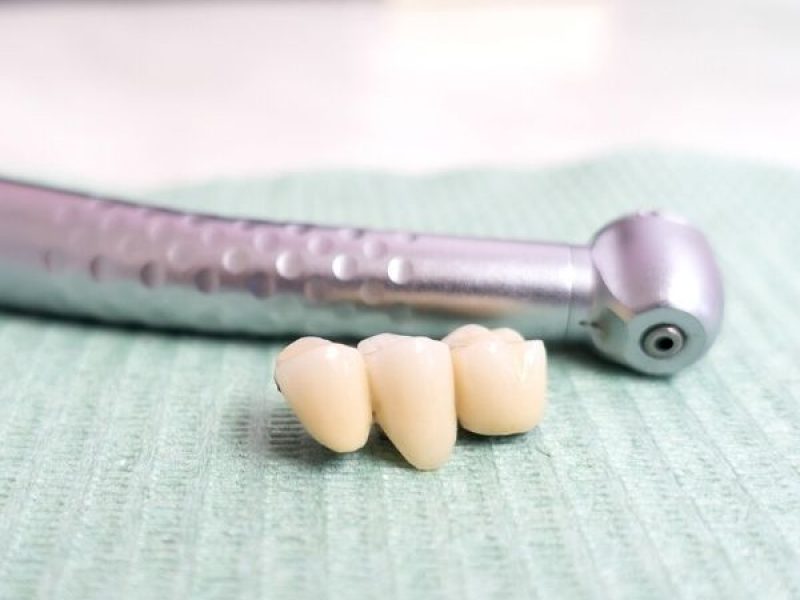

What Is a Dental Bridge?
A dental bridge, sometimes called a fixed partial denture, is a custom-made replacement for one or more missing teeth. It bridges the gap: the false tooth in the middle is attached to anchors on either side. A fixed bridge is cemented in place and can only be removed by a dentist, so you brush and chew with it like your own teeth.
A bridge is not the only way to fill a gap. Partial dentures are removable and ask less of the teeth on either side, and partial dentures for back teeth covers that situation specifically. Implant-supported dentures sit between the two.
Why Replace a Missing Tooth With a Bridge?
Replacing a missing tooth protects the teeth you still have. When a gap is left open, the neighboring teeth tend to tip and drift into it, the opposing tooth can move toward the space, and your bite slowly changes. That can make the remaining teeth harder to clean and put extra stress on them. Our post on what happens if you wait to replace a missing tooth explains the timeline.
A bridge also restores everyday function. It helps you chew food evenly on both sides, can make speech clearer when a front tooth is missing, and supports the lips and cheeks so the face does not look sunken where a back tooth is gone. For many patients the biggest benefit is the confidence of smiling without a gap.

What Happens at Your Dental Bridge Appointments?
Most traditional bridges take two visits, a couple of weeks apart.
First visit: preparation. After numbing the area with local anesthetic, Dr. Tummala reshapes the abutment teeth on either side of the gap so crowns can fit over them. She then takes a precise impression of your teeth and bite, which goes to a dental lab where your custom bridge is made. You leave with a temporary bridge that protects the teeth and fills the gap in the meantime.
Second visit: placement. The temporary comes off, and the permanent bridge is checked for fit, bite and shade before it is cemented in place. Some cases need a short third visit for adjustments.
What Is a Dental Bridge Made Of?
Bridges are usually made of porcelain fused to metal, all-ceramic materials such as zirconia, or gold alloy. Porcelain and ceramic are shaded to match your natural teeth, which matters most for a bridge near the front of your smile. Metal and gold are stronger for back teeth that take heavy chewing forces. We will go through the options and what each means for appearance and durability.

How Do You Care for a Dental Bridge?
A bridge is cleaned much like your natural teeth, with one extra step. Because the false tooth sits just above the gum, food and plaque can collect underneath it. A floss threader, bridge floss or a water flosser lets you clean under the pontic every day.
Keep up your regular checkups and cleanings so we can check the abutment teeth and the gum around them. Those teeth carry the bridge, so keeping them free of decay and gum disease is what gives a bridge its longevity, and it protects your overall oral health too.
What Affects the Cost of a Dental Bridge?
We do not publish a single price for a dental bridge, because the cost depends on what your mouth needs. The main factors are:
- How many teeth are being replaced, which sets the number of units in the bridge
- The type of bridge and the material
- Whether the abutment teeth need other treatment first, such as a filling or a root canal
- Whether your dental plan covers part of the treatment
After your consultation, we explain the cost of your treatment plan before anything starts, and our financial policy explains how payment works.
Dental Bridges Near Meyerland, Bellaire and Southwest Houston
Our office is at 4455 N Braeswood Blvd, Suite 201, Houston, TX 77096, a short drive from Bellaire, Westbury, Willow Meadows and West University Place. Because a bridge takes two or more visits, having your dentist close to home makes each appointment easier to fit around your week.
If you are missing a tooth, call 713-723-7200 or request an appointment for a consultation. We will look at the gap, take an x-ray and talk through your options, including whether another way of replacing a missing tooth would suit you better.
Frequently Asked Questions
How long does a dental bridge last?
With good daily care, many bridges last ten to fifteen years, and some go longer. What usually decides it is not the bridge itself but the teeth holding it up. Those supporting teeth still need brushing, flossing and regular checkups, because decay underneath a bridge is the most common reason one has to be redone.
Is a bridge or an implant better for one missing tooth?
Both work, and neither is automatically right. A bridge is quicker and does not involve surgery, but it has to be anchored to the teeth on either side, which means reshaping healthy enamel. An implant stands on its own and leaves those teeth untouched, but it takes longer and needs enough bone to hold it. Dr. Tummala will look at the neighboring teeth and your jawbone and talk you through which suits your situation.
Do the teeth next to the gap need to be healthy?
They do, and this is often the deciding factor. A bridge puts extra chewing load on those two teeth, so they need enough solid structure and healthy gum and bone underneath. If one of them is already heavily filled or weakened, we may suggest a different approach rather than asking it to carry more work.
How many teeth can one bridge replace?
It depends less on the number and more on what is holding it. A bridge spanning one or two missing teeth is common. Longer spans put more strain on the supporting teeth, so at some point another option makes more sense. We will measure the gap and check the anchor teeth before recommending anything.
Will a bridge change how I eat or talk?
There is usually a short adjustment period. For the first week or so a bridge can feel bulky, and certain sounds may take a little practice. Most people stop noticing it fairly quickly. Start with softer foods and cut things into smaller pieces while you get used to it. If it still feels wrong after a couple of weeks, call us at 713-723-7200, because a small adjustment often fixes it.