

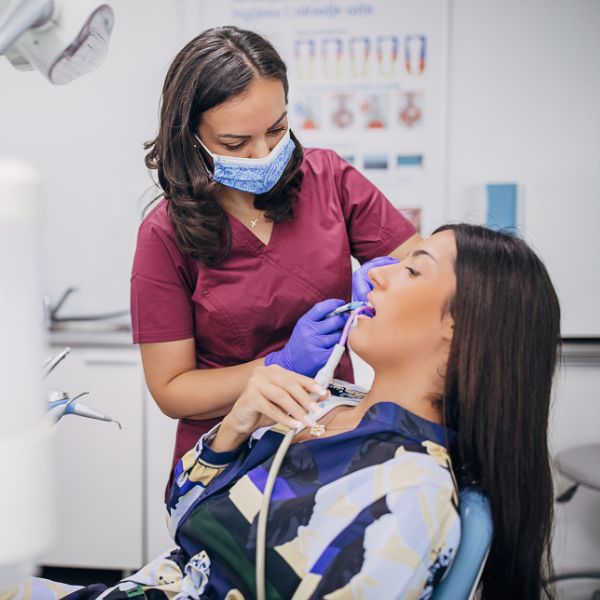
Periodontal disease is a serious infection under your gumline.
ARESTIN® (minocycline hydrochloride) is an antibiotic that kills the bacteria that causes the infection.
- It’s placed directly in the infected areas—or “pockets”—in your gums.
- It’s applied right after scaling and root planing, the dental procedure that disrupts stubborn plaque and bacteria below your gum line—where brushing and flossing can’t reach.
ARESTIN® starts working quickly, right at the source of infection, and keeps fighting bacteria long after you leave the dental office. 1,2
ARESTIN® fights infection and inflammation for 30 days,2 and provides significantly better results than scaling and root planing alone for up to 90 days.3
1. Oringer RJ, Al-Shammari KF, Aldredge WA, et al. Effect of locally administered minocycline microspheres on markers of bone resorption. J Periodontol 2002;73:835-842.
2. Goodson JM, Gunsollwy JC, Grossi SG, et al. Minocycline HCl microspheres reduce red-complex bacteria in periodontal disease therapy. J Periodontol 2007;78(8):1568-1579.
3. Williams RC, Paquette DW, Offenbacher S, et al. Treatment of periodontitis by local administration of minocycline microspheres: a controlled trial. J Periodontol 2001;72:1535-1544.
Frequently Asked Questions
Why would I need an antibiotic as well as a deep cleaning?
Because cleaning and antibiotics do different jobs. Scaling and root planing physically removes the hardened deposits and disrupts the bacteria clinging below the gumline, but some bacteria survive deep in the pocket where instruments cannot reach every surface. Arestin is placed directly into the pocket afterward so it keeps working on what is left. It is an addition to the cleaning, not a replacement for it.
What does having it placed involve?
Very little. It goes in immediately after the deep cleaning, as a fine powder placed straight into the pocket, and it does not require an injection or a separate appointment. There is nothing to take home and no course of tablets to remember. Most people are surprised how quick that part is.
What should I avoid afterward?
We will give you specific instructions, and following them matters because the medication needs to stay where it was placed. That usually means avoiding hard, crunchy or sticky foods for about a week, not poking the area, and holding off on flossing those particular teeth for around ten days. Brushing continues as normal everywhere else.
Will one treatment be enough?
Sometimes, but often not, and it depends on how deep the pockets were and how they respond. Gum disease is a long term condition rather than a one time repair, so Arestin is generally used as one part of a plan that also includes the deep cleaning and ongoing periodontal maintenance. We measure the pockets again at follow up visits and decide from there.
Is this an alternative to deep cleaning or gum surgery?
No. Arestin works alongside scaling and root planing, not instead of it, and it does not replace surgical treatment where that is genuinely needed. If someone offers you an antibiotic as a way to skip the cleaning, that is not how it works. Our gum disease treatment page explains the options properly.