

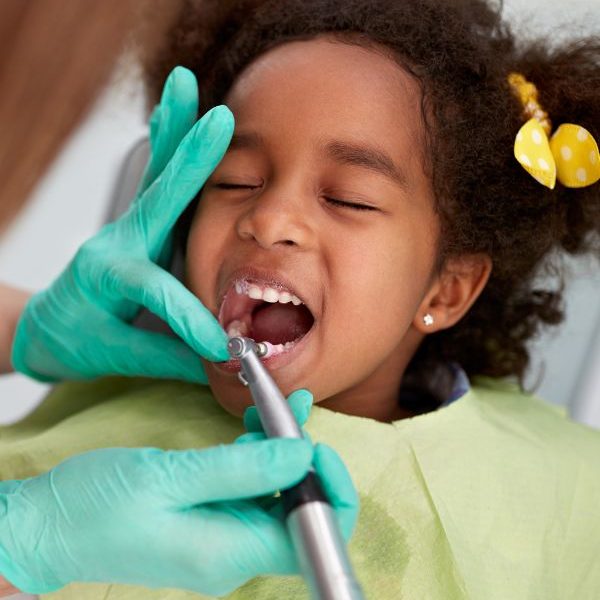
Your child’s first visit
The first “regular” dental visit should be just after your child’s third birthday. The first dental visit is usually short and involves very little treatment. We may ask you to sit in the dental chair and hold your child during the examination. You may also be asked to wait in the reception area during part of the visit so that a relationship can be built between your child and your dentist.
We will gently examine your child’s teeth and gums. X-rays may be taken (to reveal decay and check on the progress of your child’s permanent teeth under the gums). We may clean your child’s teeth and apply topical fluoride to help protect the teeth against decay. We will make sure your child is receiving adequate fluoride at home. Most important of all, we will review with you how to clean and care for your child’s teeth.
What should I tell my child about the first dental visit?
We are asked this question many times. We suggest you prepare your child the same way you would before their first haircut or trip to the shoe store. Your child’s reaction to his first visit to the dentist may surprise you.
Here are some "First Visit" tips:
- Take your child for a "preview" of the office.
- Read books with them about going to the dentist.
- Review with them what the dentist will be doing at the time of the first visit.
- Speak positively about your own dental experiences.
During your first visit the dentist will:
- Examine your mouth, teeth and gums.
- Evaluate adverse habits like thumb sucking.
- Check to see if you need fluoride.
- Teach you about cleaning your teeth and gums.
- Suggest a schedule for regular dental visits.

What about preventative care?
Tooth decay and children no longer have to go hand in hand. At our office we are most concerned with all aspects of preventive care. We use the latest in dental sealant technology to protect your child’s teeth. Dental sealants are space-age plastics that are bonded to the chewing surfaces of decay-prone back teeth. This is just one of the ways we will set the foundation for your child’s lifetime of good oral health.
If your child has trouble feeding or forming certain sounds, tongue tie and how a dentist can help explains what to look for and when it is worth checking.
Cavity prevention
- Limit frequency of meals and snacks.
- Encourage brushing, flossing and rinsing.
- Watch what your child drinks.
- Avoid giving your child sticky foods.
- Make treats part of meals.
- Choose nutritious snacks.
The first baby teeth that come into the mouth are the two bottom front teeth. You will notice this when your baby is about 6-8 months old. Next to follow will be the 4 upper front teeth and the remainder of your baby’s teeth will appear periodically. They will usually appear in pairs along the sides of the jaw until the child is about 2 1/2 years old.
At around 2 1/2 years old your child should have all 20 teeth. Between the ages of 5 and 6 the first permanent teeth will begin to erupt. Some of the permanent teeth replace baby teeth and some don’t. Don’t worry if some teeth are a few months early or late as all children are different.
Baby teeth are important as they not only hold space for permanent teeth but they are important to chewing, biting, speech and appearance. For this reason it is important to maintain a healthy diet and daily hygiene.
Frequently Asked Questions
Do baby teeth really matter if they fall out anyway?
They matter a great deal. Baby teeth hold the space for the adult teeth coming in behind them, and losing one early lets the neighboring teeth drift into the gap, which is a common cause of crowding later. They also affect how a child eats and forms speech sounds. And decay in a baby tooth can be painful and can affect the developing adult tooth underneath. Treating them is not wasted effort.
How much toothpaste should my child use?
Less than most people think. For children under three, a smear about the size of a grain of rice is enough. From three to six, a pea-sized amount. The reason for the small quantity is that young children swallow rather than spit, and too much fluoride while adult teeth are forming can cause white marks on them. Supervise brushing so you can control how much goes on the brush.
When can my child brush on their own?
Later than most children would like. Young children do not have the manual dexterity to clean thoroughly, and the usual guidance is to keep helping until around age seven or eight. A practical middle ground is to let them have a go first so they build the habit, then you go over it afterward. The back teeth and the gumline are the areas children reliably miss.
My child grinds their teeth at night. Should I be worried?
Usually not. Grinding is very common in children and most outgrow it without any treatment, often as the adult teeth come through. Mention it at your next visit so we can check for wear. It is worth looking at sooner if your child complains of jaw pain or headaches in the morning, if you can see teeth visibly flattening, or if the grinding is loud enough to disturb their sleep.
What if my child knocks out a tooth?
This depends on which kind of tooth, and the difference matters. If it is a permanent tooth, handle it by the crown, keep it moist in milk, and call us immediately, since time is critical. If it is a baby tooth, do not try to put it back in. Reinserting a baby tooth can damage the adult tooth developing above it. Control any bleeding with gentle pressure and call us so we can check the area. Either way, ring 713-723-7200 or see our emergency care page.